WenweiOS is my personal knowledge base, and the place where I live alongside AI. What happens each day, the books I read, my conversations with AI and the projects I’ve made are all Markdown files in one folder, which I browse in Obsidian and which an AI coding assistant (currently Claude Code) helps me save and organise.
The first commit was on August 8, 2026; in three months there were over six hundred, and I still use it.
Why
I wanted an assistant that remembers my stuff. Conversations, books, old projects: they were scattered across note apps, chat logs, email and hard drives, and I could never find them when I needed them.
…This OS is my own real need. I feel it can already be used directly for my résumé and for making things.
What it looks like
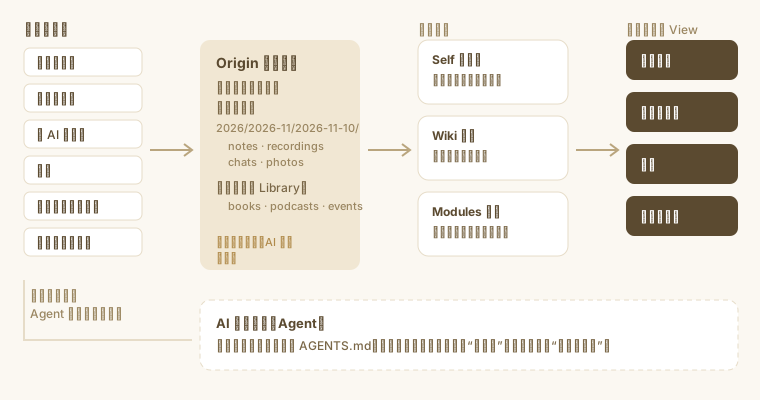
- Origin (raw material): filed by date, with subfolders for notes, recordings, chats and photos; books, podcasts and events I’ve been to go in Library. Originals are never rewritten or polished; any necessary correction keeps the original and says what changed.
- Self (about me): how I describe myself, my principles, what I’ve done, and the people around me, mostly in my own words, dated and linked back to the source.
- Wiki (knowledge): things we’ve discussed and settled, written like encyclopedia entries. I decide what gets an entry.
- Modules (lists): bookshelf, projects, topic ideas, blog, fitness, spending… each with its own rules at the top of its main file.
- Index: indexes generated by AI that can be rebuilt any time.
A few rules
The rules live in AGENTS.md at the root, and the AI reads it before every session. The most important ones:
- Keep raw material as it is.
- Keep voices apart. My words, outside sources (in quote blocks) and the AI’s words (marked as AI notes) are kept separate. What the AI says isn’t my opinion.
- When unsure, mark it “to confirm”. No guessing dates, names or numbers. “Speaker 1” in a transcript isn’t anyone in particular.
- For private things, only say where they were said. Details stay in the original; elsewhere there’s only a link.
- Keep the rules short. When changing them, delete and merge first, then add.
How I use it
I mention something in a chat and the AI saves the conversation in that day’s folder, then adds the relevant parts to my experience, bookshelf or projects. When I’m thinking something through, it looks for whether I’ve said something similar before; when I remember something from years ago, it goes looking for evidence on old drives and in old emails.
To bring old material in, we wrote import tools and skills together: whole e-books, notes from Ulysses and flomo, transcripts from Tongyi Tingwu recordings, chat history from various AI platforms, plus WeChat article drafts and Xiaohongshu cards.
Reading while talking with AI
These days I read by talking with AI as I go. It’s been the most fun thing lately.
- Each book has its own folder: the text (an imported e-book), a “reading conversation” with AI, a file of “associations”, and a word list for English books;
- when a passage strikes me, I hand it to the AI and ask how to read it, or tell it what it made me think of. The conversation is saved as it is in that book’s reading conversation, with my words and the AI’s kept apart;
- after finishing a book, we build a mind map together: five to ten highlights at a time, discussed one by one and hung in the right place, each node linking back to the original text;
- concepts we’ve worked through become entries in the knowledge base, like “flow” and “deliberate practice”.
My highlights used to be scattered across reading apps. Now what I read slowly connects, and when I come across something related, I can find where I thought about it before.
Data and views
Something became clear to me later: this knowledge base is the underlying data, and everything else is a “view” of it. The projects and events on this site were compiled by AI from my code repositories since university, more than three thousand emails from my student ambassador years, and an external drive, first as records in the knowledge base and then rewritten as web pages. To change something on the site, I change it in the knowledge base first.
More of my thinking is in a post, My personal agent is a folder (in Chinese).
It holds everything I built before
At some point I realised that several things I’d built before had grown back inside WenweiOS:
- Keeping track of reading: the Notion knowledge base API and reading notes app from university, and my graduation project Bookworm, have become one folder per book and reading while talking with AI;
- Looking up words: the Anki flashcard script, Read Flow and Word Pebble became asking about a word as I read and adding it to that book’s word list;
- What to do after work: Serendip wanted to help me decide what to do tonight; now I talk with AI about how the day goes and log workouts and meals;
- An agent that remembers me: Floss was its predecessor, and those conversations were brought in.
I suddenly realised my WenweiOS has merged so many things from today: keeping track of reading, looking up words, what to do after work. Everything has melted into it. It feels magical!
What I want to try next
Right now it serves only me. I wonder: if everyone had an agent like this that knew them over the long run, could those agents help people find someone worth meeting, or someone who’s been through a similar stage and could share what they learned? It’s still a question mark.